Purpose
- Investigates the causes of economic imbalances.
- Explores and develops market-based solutions.
Summary
The Nature Conservancy will address the economic imbalance of island nations in Micronesia whose livelihoods and food sources are at risk from market forces, both internal and external, that are creating unsustainable fishing conditions while weakening traditional management systems. In response, we will work with Micronesian partners to assess the impact of internal and external market forces on traditional practices and marine resource sustainability; integrate rights-based and traditional management systems into combined approaches for Micronesia’s coastal fisheries; develop innovative sustainable financing options for coastal fisheries management; and lay the groundwork to roll out and refine these approaches across Micronesia within the framework of the Micronesia Challenge. If funding is approved to a second year, the project will be expand to Hawaii.
Description
The final report on “An Interdisciplinary Study of Market Forces and Nearshore Fisheries Management in Micronesia” has been completed and is now able to be downloaded from this site.
Reference: Rhodes, K.L., Warren-Rhodes, K., Houk, P., Cuetos-Bueno, J., Fong, Q. and Hoot, W. 2011. An Interdisciplinary Study of Market Forces and Nearshore Fisheries Management in Micronesia. A Report of the Marine Program of the Asia Pacific Conservation Region, The Nature Conservancy. Report No. 6/11. 120pp.
The study examines the market forces driving overfishing in the eight jurisdictions of the Micronesia Challenge region: Republic of Palau, Federated States of Micronesia (Yap, Chuuk, Pohnpei and Kosrae), Republic of the Marshall Islands, Commonwealth of the Northern Mariana Islands, and Guam.
The purpose of the study was to undertake an interdisciplinary assessment and analysis of the market forces, both internal and external, that are driving the increasing demand for coastal fish resources within Micronesia; and to investigate the potential opportunities to reinforce community and traditional rights-based coastal fisheries management with contemporary rights-based and market-based fisheries management approaches that are increasingly being applied internationally to manage fisheries. While Micronesia’s coastal fisheries are recognized by its leaders as being increasingly overharvested, there is also a weakening of traditional rights-based coastal fisheries management. This is occurring at a time when internationally there is mounting recognition of the potential of rights-based and market-based fisheries management approaches.
The study’s overall conclusion is that coastal fisheries are in decline throughout Micronesia and a substantial reduction in catch volume is needed until sustainable management targets can be achieved. To accomplish this, reforms in the ways that coastal fish are marketed and managed are needed in all jurisdictions to ensure long-term socio-economic security, including providing equity to fish prices and the protection of undersized fish and spawning stocks to improve fish population growth. Catalyzing declines of marine resources in some jurisdictions are open access property regimes that dampen the sense of resource ownership and responsibility and stimulate the “race to fish.” Resource declines were typically most severe in open access jurisdictions, while those with low population density and those operating under stronger and more intact customary marine tenure systems tended to be less overfished. Nonetheless, degraded fisheries and impacts to fish stocks from unsustainable fishing practices were noted in all jurisdictions, regardless of the level of traditional management being exercised.
A number of key socio-economic drivers were found to contribute to marine resource declines: (1) the change from a subsistence to cash economy; (2) an erosion of customary marine tenure; (3) a lack of political will for protecting marine resources; (4) an absence of effective, responsive fisheries management; (5) increasing population pressures and demand for reef resources, including export; (6) undervalued reef and pelagic resources; (7) high external commodity costs; (8) unsustainable use of modernized fishing gear; (9) an erosion of traditional fishing ethics and practices; and (10) a paucity of educational and alternative employment opportunities.
Based on these drivers and an assessment of current management practices, the study synthesizes the economic, policy, and stakeholder actions that can be taken to address unsustainable fishing in Micronesia. Regional efforts to control overfishing and provide enhanced protection for marine resources, such as the Micronesia Challenge, are crucial to long-term management success and sustained fisheries. However, these efforts alone will not prevent overfishing unless the identified political and socio-economic drivers are addressed. Identifying ways to reduce the harvest and demand for marine products, transitioning fishers away from fisheries, streamlining policymaking, and restoring sustainable harvest techniques are all paramount to overall conservation success. The report suggests specific actions that can be immediately implemented by governments, managers, and NGO partners to improve fisheries and management responses.
EXECUTIVE SUMMARY
For Micronesians, the sea and its bounty have been a central part of daily life for thousands of years, as reflected in their lore and customs. However, unbalanced commercialization of coastal resources and a lack of parallel management have allowed unsustainable fishing practices to abound, with coastal fisheries now characterized by excess harvest and unethical and destructive fishing methods. Across Micronesia, poor management of commercial fishing has resulted in the virtual extinction of some species in some jurisdictions, reductions in abundance and mean fish size, age, and fecundity for many commercially important nearshore species, changes in coastal fish communities, and severe impacts to the reproductive and replenishment potential of fish spawning aggregations. Adding to this are poor land use and development activities, such as dredging, unabated pollution, and upland land clearing that have contributed to degraded coastal and nearshore habitats, particularly coral reefs. Today, the regional commercial reef fishery is threatening the economic potential and development of non-extractive industries (e.g., tourism), as well as socio-economic and food security. Thus, there is an urgent need to lessen the impacts through better, restructured management institutions (along with their policies and actions).
The current study examines market forces driving overfishing in the eight jurisdictions of Micronesia: Yap, Kosrae, Pohnpei and Chuuk, Palau, the Marshall Islands, the Northern Mariana Islands, and Guam. Case studies, fisher surveys, and literature reviews were used to analyze the historical context of coastal fisheries and to identify potential changes in socio-economic, political, and management practices that could improve sustainability. Similar to past research on these subjects, this study’s overall conclusion is that coastal fisheries are in decline throughout Micronesia and a substantial reduction in catch volume is needed until sustainable management targets can be achieved. To accomplish this, reforms in the ways that coastal fish are marketed and managed are needed in all jurisdictions to ensure long-term socio-economic security, including providing equity to fish prices and the protection of undersized fish and spawning stocks to improve fish population growth. Catalyzing declines of marine resources in some jurisdictions are open access property regimes that dampen the sense of resource ownership and responsibility and stimulate the “race to fish.” Resource declines were typically most severe in open access jurisdictions, while those with low population density and those operating under stronger and more intact customary marine tenure systems tended to be less overfished. Nonetheless, degraded fisheries and impacts to fish stocks from unsustainable fishing practices were noted in all jurisdictions, regardless of the level of traditional management being exercised.
A number of key socio-economic drivers were found to contribute to marine resource declines: (1) the change from a subsistence to cash economy; (2) an erosion of customary marine tenure; (3) a lack of political will for protecting marine resources; (4) an absence of effective, responsive fisheries management; (5) increasing population pressures and demand for reef resources, including export; (6) undervalued reef and pelagic resources; (7) high external commodity costs; (8) unsustainable use of modernized fishing gear; (9) an erosion of traditional fishing ethics and practices; and (10) a paucity of educational and alternative employment opportunities.
Based on these drivers and an assessment of current management practices, the study synthesizes the economic, policy, and stakeholder actions that can be taken to address unsustainable fishing in Micronesia. Currently, one of the biggest drivers of overfishing is the disparity between wholesale fish prices and external commodity prices, particularly fuel. This disparity, together with the inability by fishers to cooperate to effectively leverage prices, is creating the framework for overharvesting. Adding to the problem are cheap, unhealthy imported meat products that compete with locally derived fish in price and which are less impacted by the wide swings in fuel prices observed over the past decade. Governments and stakeholders should work to institute fair commodity pricing and identify other plausible means to suppress the demand, or at least capture volume, of nearshore fishes. To assist in achieving a fair market price, regional fishers are urged to form cooperative agreements and strengthen their ability to collectively bargain. Governments should also discourage the importation and consumption of the low cost, unhealthy meat products helping to drive diabetes and obesity in the region. Alternatively, markets and governments should work together with fishers to impose mechanisms to upwardly adjust wholesale fish prices and diminish overall coastal fish consumption.
The abolition of destructive fishing practices, protection of critical habitat, and severe restrictions on the harvest of highly vulnerable species, such as green bumphead parrotfish, humphead wrasse, tridacnid clams, and turtles should be paramount management goals. SCUBA spearfishing, blast fishing, fishing with poisons, and gillnetting should be banned throughout Micronesia due to their known association with habitat destruction and overfishing. Regionally, the healthiest fish communities are found in areas free of these techniques. Nighttime spearfishing, while popular, is perhaps the primary driver for unsustainable fishing and must be severely curtailed and eventually eliminated if sustainable fisheries are to be realized. Along with managing gear, there is a need to protect known fish spawning areas and fish spawning periods, along with instituting methods that allow juveniles to attain reproductive size and age, such as size limits.
In all study locales, management success, whether at the community, state, or national level, was always associated with a dedicated environmental champion whose primary focus was to identify, design, and facilitate management and conservation laws or practices. Alternatively, management failures were linked to a weak political will to prioritize and drive legislation and enforcement for resource protection. Management success was also linked to systems with well-defined user-rights, such as customary marine tenure systems or locally managed marine areas. Enforcement was noted as a key area for improvement in all jurisdictions.
To stem declines in coastal fisheries, open access jurisdictions should be restructured to allow finer divisions of ownership and management of marine resources. The expansion and support of locally managed marine areas, which includes greater community involvement in nearshore resources monitoring and protection, should be supported. Further, recent surveys found wide interest among fishers in involvement with management decision-making, monitoring, and enforcement activities. The paucity of state and national fisheries management successes and the lack of sufficient resources within state and national governments support a move toward co-management, with greater involvement from fishers.
Fisheries development activities, specifically government loans and international subsidies, were identified as being detrimental to sustainable fisheries. The study found that subsidies overwhelmingly promote fisheries development in areas already impacted by overfishing, whereas loans provide easy entry into overpopulated fisheries, while placing greater economic burdens on fishers. There is an urgent need to restructure loan and subsidy programs that promote overharvesting to ones that assist conservation and management actions.
Finally, the export of nearshore marine products is adding to unsustainable catch volumes in the region. Many jurisdictions have relatively low export levels; however, even these smaller volumes add to the burdens on coastal ecosystems, particularly where overfishing is already severe. Restrictions on reef fish export are one of a number of methods needed to reduce nearshore marine resource harvest volumes. In other jurisdictions, where export is a major component of the local economy, fees on exports and improved pricing of export products are urged to help suppress demand from importing countries and provide greater revenue to local fishers and marine resource agencies. In all jurisdictions, the best management policy is to institute an export ban on all wild-caught coastal marine products.
The study identified a number of means to boost revenue for fisheries management, focusing on the development or expansion of marine resource user fees, airport taxes, entrepreneurial businesses, and enhanced revenue from equitable pricing and export of marine resources. New revenues, when strictly dedicated to conservation and management and separated from general funds, can be an invaluable means to prevent or reverse resource declines. Market corrections are needed to improve living standards among fishers, suppress demand and consumption, boost revenues to management agencies, and reduce the impacts of overharvesting.
To bolster monitoring and enforcement efforts, governments should enlist private industry. A number of marine resource-based industries, such as the dive tourist industry, could support management and monitoring efforts. Many private industries are better funded, better equipped, and have a greater presence in the marine environment than state-run agencies. Providing a legal framework to these industries to engage in monitoring and enforcement activities should be a priority.
Although it is relatively easy to show marine resources decline in the region, our ability to clearly characterize fisheries status and trends, and provide sharply focused management recommendations, was hindered by a lack of reliable, long-term data. This ongoing dilemma will continue to make well-informed management problematic and create difficulties in gauging successes and failures of management action. For some jurisdictions, no reliable information was available, although there were clear concerns among stakeholders about the declining state of marine resources. While precautionary, data-less management should be a key component of Micronesian marine resource management, information on marketed and exported marine resources is critical toward understanding fisheries impacts and allowing the development of sound, effective management strategies.
Regional efforts to control overfishing and provide enhanced protection for marine resources, such as the Micronesia Challenge, are crucial to long-term management success and sustained fisheries. However, these efforts alone will not prevent overfishing unless the political and socio-economic drivers identified herein are addressed. Identifying ways to reduce the harvest and demand for marine products, transitioning fishers away from fisheries, streamlining policymaking, and restoring sustainable harvest techniques are all paramount to overall conservation success. We, therefore, urge all stakeholders, government agencies, and NGO partners to place equal attention and focus on harvest reduction to enable long-term sustainable marine resource management and conservation goals to be met.
2016 Update on outcome of previous grants
This is an update of what has been happening with the Northern Reef Fisheries Project for which TNC is leading with local partners to improve management (see attached brochure).
By way of history, you supported a lot of the initial work looking at market drivers for which we realize there was not a good process that existed to support both management of fisheries, as well as how to improve the value chain. We started the northern reef project by engaging with fishermen to explore opportunities to improve management, as well as figure out a system that can help fishermen began to think how they can improve the value chain to ensure sustainable fisheries resource, as well as improved benefits to them. Our work with fishermen through the data poor stock assessment showed that fishermen were fishing too hard. They were already catching fish before they had the chance to reproduce; that the market controls the price of fish because it monopolize the fishermen because there is no established supply chain; and that there were many fishermen accessing the reefs with no control in place. The fishermen were competing for a declining resource, hastening fisheries decline.
With the understanding of these issues, we began to explore efforts on how to (1) recover the fish stocks, (2) organize fishermen, and (3) improve enforcement.
Fish stock recovery
For the recovery of fish stocks, the fishermen and their respective state governments decided to (1) put a 3 year moratorium on 5 species of groupers, (2) establish size limit for 8 commonly targeted reef fish, (3) establish fish permit system for subsistence, commercial, and recreational, (4) establish fishing zone for subsistence, commercial, and recreational, (5) establish an additional 6mi2 of protected area that covers water for Kayangel and Ngarchelong State, (6) establish boat registration (7) put moratorium on lobster, female mangrove crab, and 2 species of giant clams
Improve fishermen engagement and benefits
We have worked with the fishermen to developed the Northern Reef Fisheries Cooperative, this is a charted NGO for the time being while we work with fishermen to strengthen the coop. The Cooperative is engaging with fishermen on exploring ways on which they can help support enforcement, i.e. awareness as well as extra eyes for enforcement; providing alternative livelihood as fish stock recovers, i.e giant clam farming – to date 13 fishermen have been identified and 5 farms have been constructed and seeded with giant clams; exploring deep water fishing – to date 4 fishermen have access to deep water fishing gear; explore participation in the tourism sector – to date at least 3 fishermen have some participation on taking visitors out on the reef; explore opportunities for improving value chain for the fishery by controlling the supply of fish from the northern reefs and establishing key markets by engaging with eco-conscious restaurant owners – to date Palau Pacific Resort has shown promising interest.
Enforcement
We have worked with the State Rangers to update their enforcement skills as well as improve infrastructure to support enforcement. We have installed 2 long range surveillance camera, one in Ngarchelong and 1 in Kayangel to help support enforcement. We are looking into establishing a floating rangers station that will further strengthen the enforcement infrastructure. We have initiated a process to establish coordination and support between State Rangers and National Fish and Wildlife enforcement process.
Update submitted by Steven Victor
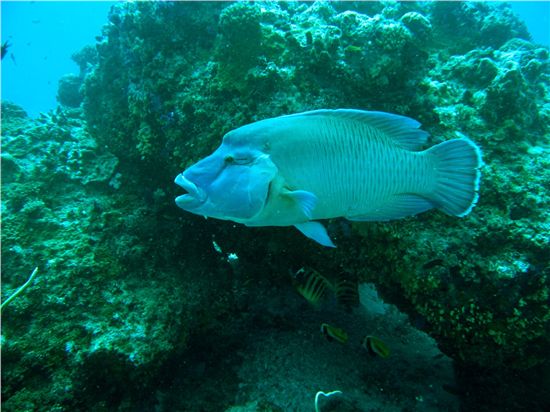
The giant Napoleon wrasse is a species that indicates a healthy ecosystem. This project aims to address the economic imbalance caused by the erosion of traditional fishing rights.
Purpose
This project will address the economic imbalance caused by the erosion of traditional fisheries rights and management by working to change marine policy to support and reinforce traditional management systems, protect vital coastal fisheries for communities and build an innovative approach to fisheries management that can be applied in Micronesia and throughout the Pacific. It will also include market-based alternatives to overfishing through improved fisheries management that will benefit communities rather than outside fishing companies.
Scope
The project will take place in the U.S. protectorates of Palau, the Federated States of Micronesia, and the Marshall Islands and the U.S. Territory of Guam and U.S. Commonwealth of the Northern Mariana Islands. In the second year we will expand the project to Hawaii, and we hope to eventually apply this model of fisheries management throughout the Pacific and in the Coral Triangle. We believe this work will revolutionize the way island leaders manage fisheries in the Pacific, the United States, and other key marine areas throughout the world.
Amount Approved$50,000.00
on 3/17/2010
(Check sent: 3/24/2010)