Purpose
- Explores and develops market-based solutions.
Summary
The Carbon Canopy joins together, under a single common umbrella, a diverse collection of stakeholders ranging from private landowners and environmental groups to multi-national corporations working together to develop innovative market-based solutions to conserve and expand ecosystem services on private forest lands in the Southern US. The Carbon Canopy is currently developing working forest carbon projects based on rigorous environmental standards with southern forest landowners to support the expansion of forest restoration, conservation and FSC certification in the Southeastern US, beginning with the Southern Appalachian region. .
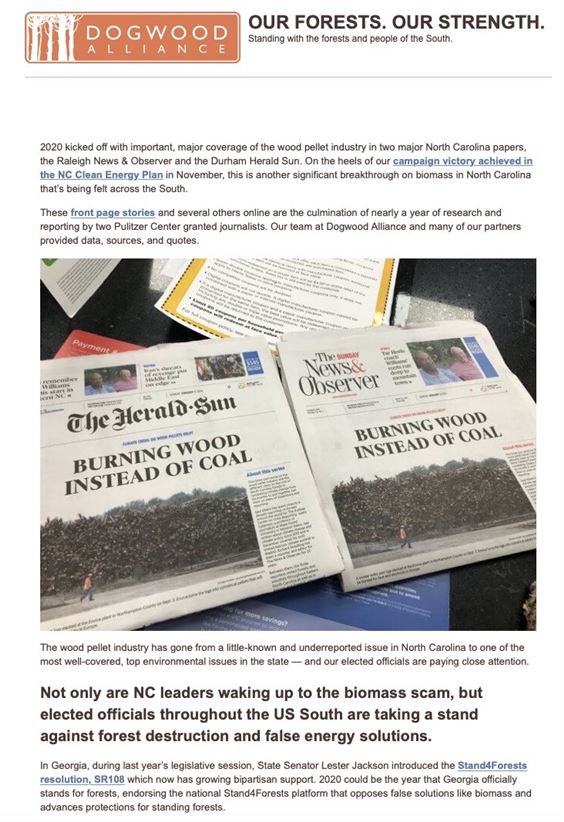
2020 Update: Ten years after initial funding from the Walker Foundation, Dogwood Alliance succeeded in gaining widespread recognition that cutting forests to fuel power plants with wood biomass is not green energy.
Description
The past few months have been an exciting and productive time for the Carbon Canopy project. What began as a creative and unique, but untested and unproven idea a few years ago, has matured into a proven concept with tangible and real financial results. We have demonstrated that there are alternatives for forest owners in the Southeast for harvesting financial returns on their forested property other than clear-cutting their land.
Carbon Canopy provides unprecedented protection for the forests of Appalachia. These forests are among the most diverse temperate forests in the world. Carbon Canopy protects the region’s unique conservation values while producing hundreds of thousands of offsets over time. Carbon Canopy landowners commit to responsible forestry practices and carbon management over a 100-year period. Our partners are in this for the long haul so our irreplaceable forests will endure for generations to come.
Some of the true benefits realized by the project so far are
• Completion of two full carbon projects on land in southwestern Virginia
• Protection of 14,000+ acres of forested land in central Appalachia for 100 years
• Forest Steward Council certification of forests on previously unregulated land that would have likely been cut or mismanaged
• Shepherded an additional 5,000+ acres of forest to FSC certification with property owners whose land was not included in Carbon Canopy
• Employment and carbon management job skills development provided to regional forest professionals
• Proven concept that demonstrates there are valid and financially successful alternatives to resource extraction for regional forest owners
• Recruited a group of corporate offset purchasers interested in buying a new product produced by Appalachian forest owners
• Procured federal government financial support for innovative conservation projects
• Evaluated fifteen potential land projects for inclusion in Carbon Canopy, gaining the skills necessary to review the viability of carbon projects more thoroughly and quickly
• Advanced four land projects to scientific data collection and carbon inventory assessment
• Advanced four other land projects into full project development with completion dates scheduled for two in 2013 and two in 2014
During the last six months the Carbon Canopy has focused on the following activities identified in its workplan timeline for this period. These activities run the gamut of tasks associated with building and expanding a project like this, from screening new potential land tracts for inclusion to completing projects and selling offsets.
Our biggest task this period resulted in our greatest success to date, bringing two of our projects to full completion and arranging sales contracts for carbon offsets from those projects. We were pleased to make a public announcement of this success at the International Greenbuild Conference in Philadelphia in November, standing alongside several of our partners at a news conference.
In the past two quarters we worked at expanding our cadre of corporate offset purchasers. We met with all of our existing partners and encouraged them to expand or enhance their investment and participation in Carbon Canopy. Domtar, Staples, Columbia Forest Products and Coca-Cola have all agreed to increase their participation and or funding in the program. We also recruited McMillan Publishing Co. as a new purchaser, and initiated conversations with Disney Corporation and UPS who have stated they too are interested in being a purchaser.
We have continued screening potential new land tracts during this period, including the Shaffer Family Farm on the Virginia/North Carolina border, and the Crummie’s Creek property spread over several counties in central West Virginia. Both of these properties are being put forward into full project development.
We are working to break down barriers that might prevent landowners or corporations from choosing to participate. We are working with Wells Fargo Bank who has offered help in designing a financing structure that would provide funds for landowners to pay for the technical services required to prepare a property as a carbon project. We have also worked out arrangements with a FSC certificate holder, Columbia Forest Products to aggregate multiple properties into one carbon project under their certificate. This would allow landowners who own smaller plots to join together to reach the critical mass in property size that makes a project financially viable.
We have evaluated past projects and identified what specific lessons we have learned in project development and the many intricacies in managing highly technical projects like ours. We will examine these lessons learned in a training and work session at our next stakeholders meeting scheduled for June that will further improve our ability to screen and evaluate potential land projects and how to work most effectively with landowners.
We have continued to reach out to land trusts as partnering with Carbon Canopy could be a boon to trusts who have land protected that is not revenue producing. We attended the National Land Trust conference just this month in an effort to educate and recruit land trusts into the project.
Our goals for the remainder of 2014 include completing 3-5 land projects totaling over 20,000 additional acres of forest that will be protected; securing at least two new major purchasers of carbon offsets from our project; developing models for a Forest Carbon Conservation Fund that would enable us to engage more and smaller landowners in the project in the future; as well as continue to grow the program with the aim of adding 20,000+ acres of protected forests annually.
Our supporters have been an integral part of creating this new paradigm, a ground-breaking initiative that puts forest management at the forefront of supply chain innovation. We are thankful to have assistance from forward thinking funders as we create the future of forest protection.
Purpose
For too long, the Southern forest economy has been based almost exclusively on resource extraction at the expense of other forest values such as carbon sequestration, water quality and biodiversity. Carbon Canopy, is working to shift this paradigm through leveraging the greening of the US marketplace into a source of revenue for landowners that commit to manage working forests for long-term carbon sinks under FSC forest management and Climate Action Reserve (CAR) carbon accounting protocols tied to conservation easements.
Scope
Forest loss and degradation account for 20% of global carbon emissions. While forest destruction in the developing world is a primary factor, a recent report from the proceedings of the National Academy of Sciences found that the US leads the world in percentage of forest cover loss, attributing much of that to industrial logging in the South where 2% of the world’s forests produce about 20% of the world’s wood and paper products.
Carbon Canopy's strategy for conserving forested landscapes focuses on creating financial value for leaving more trees (and carbon) in the woods. By strategically engaging key players in the forest industry in the largest wood and paper producing region of the world our work informs national and even global forest conservation and climate policies.
Amount Approved$20,000.00
on 11/18/2011
(Check sent: 11/25/2011)