Purpose
- Explores and develops market-based solutions.
Summary
After decades of conflicts between wildlife and public land livestock grazing in the greater Yellowstone ecosystem, NWF entered the scene in the early 2000’s with a novel approach to ameliorate these conflicts. Over the last two-plus decades, staff from the Wildlife Conflict Resolution program (WCR) refined a strategy that compensates ranchers for voluntarily waiving their livestock permits, thereby removing their livestock from those conflict grazing allotments. NWF’s grazing retirements benefit myriad species, but our primary focus is to enable the expansion of large carnivores like wolves and grizzlies and bighorn sheep. The geographic focus of this proposal is Southern Utah and the Grand Staircase- Escalante and Bears Ears National Monuments. As discussed with the trustees and as noted below, we shifted some of our work to the Wind River Reservation in support of the Buffalo reintroduction efforts by the Eastern Shoshone and Northern Arapahoe Tribes.
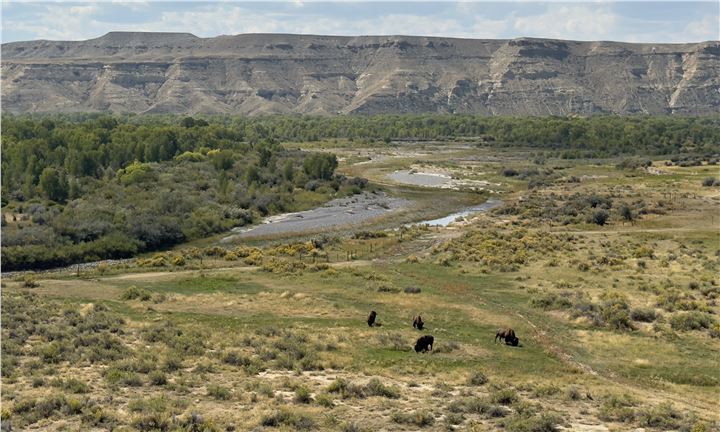
Buffalo grazing on a small section of the Wind River Reservation. The goal of the project is to re-establish buffalo as a wildlife species, not just livestock. The Eastern Shoshone and Northern Arapaho tribes have a long-term vision of re-establishing thousands of freely-roaming buffalo on tribal lands, managed under tribal law.
Description
As described in the grant application, our intent was to continue negotiating the retirement of nearly three quarters of a million acres of grazing allotments in the Bears Ears area of southeastern Utah. We also intended to continue our work collaborating with our partner the Grand Canyon Trust in identifying additional grazing permittees that might be open to a compensated grazing permit waiver transaction. The election of Donald Trump created a political environment that has created significant challenges to moving forward with the negotiation of the large transaction and made our efforts to pursue additional transactions difficult. The result has been a shift in strategy in Southern Utah including the pursuit of a couple of strategies. First, we are poised to engage a fight against the administration's expected reduction of both the Grand Staircase-Escalante and Bears Ears National Monuments. Second, we are exploring the potential of negotiating agreements with ranchers to reduce their stocking rates on high priority allotments. Our chance of producing significant conservation outcomes is admittedly reduced, but this is a landscape we are committed to and will continue to invest time and energy, albeit at a lower level than during the Biden Administration.
Because of our reduced time spent working in this landscape, in 2025, we increased our investment in working with the Eastern Shoshone and Northern Arapahoe Tribes on the Wind River Reservation on work to retire tribal range units. That strategy uses essentially the same approach we have used for over 20 years on USFS and BLM land, but takes it to tribal land. We began the conversation with the Wind River Tribes to employ this approach starting six years ago, but following a series of decisions by both Tribal Councils in the summer of this year, we are now able to start negotiating with those ranchers who hold Range Unit permits on the Reservation. Laying the groundwork for using this strategy on the Reservation was time consuming, but we believe we are poised to begin serious negotiations this late fall and winter. The potential over the next five to ten years is to retire as much as 750,000 acres of cattle permits on the Reservation with the expectation that this land will be made available for the growing buffalo program. Because of the significantly limited opportunities to retire grazing allotments on federal land, we will use this time instead to work with the Tribes on the Wind River Reservation over the coming three years.
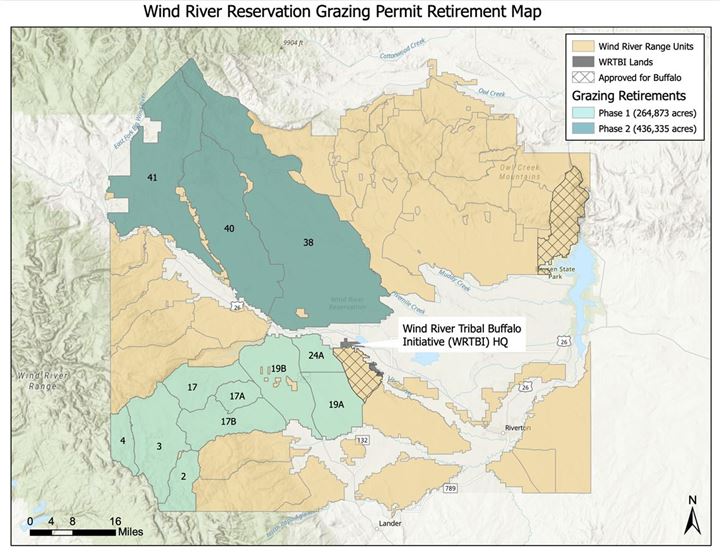
Wind River Reservation Grazing Permit Map, showing proposed transitioning of grazing leases from cattle to buffalo.
Purpose
Beginning in 2001, NWF began using a market- based approach that recognized the economic value of grazing permits and offer to compensate ranchers for waiving their permit. We then receive assurances for from the agency that the allotment will not be restocked with livestock. In an effort to apply our model to new landscapes and to continue to innovate, we will adapt our allotment retirement model in Grand Staircase- Escalante National and Bears Ears National Monuments by testing what we are calling "AUM buy- downs." We should add that we are currently pursuing opportunities in both Monuments to fully retire several grazing allotments. In addition, we are bringing our grazing allotment retirement approach to the Wind River Reservation.
Scope
NWF has used this approach to address conflicts between large carnivores in the Greater Yellowstone Ecosystem and beyond in the Northern Rockies for the last 22 years and in addition has employed the strategy to reduce conflicts between domestic and bighorn sheep. Because of the absence of large carnivores in the Southern Rockies and Great Basin, we have only focused on retiring domestic sheep allotments. With the recent proclamation re-constituting the Grand Staircase- Escalante and Bears Ears National Monuments in Utah, we will continue to invest time and resources in allotment retirement and AUM buy-down opportunities in Utah over the coming year. Please note that over the last year of outreach, we are starting to generate some exciting opportunities in these two Monuments (see most recent project report). On the Wind River Reservation we are targeting the retirement of range unit cattle permits to create space for buffalo.
Information Dissemination
In the past when we've completed a grazing allotment transaction on USFS and BLM land, we were necessarily careful about publicizing our results, due to the controversial nature of this conservation strategy and our need to maintain a good relationship with ranchers. However, we will need to be much less concerned with these dynamics when we have success on the Wind River Reservation and will plan on being much more aggressive in publicizing our work.
Amount Approved$40,000.00
on 10/23/2024
(Check sent: 11/7/2024)