Purpose
- Investigates the causes of economic imbalances.
Summary
This grant will expand high quality climate and energy news coverage in the Mountain West.
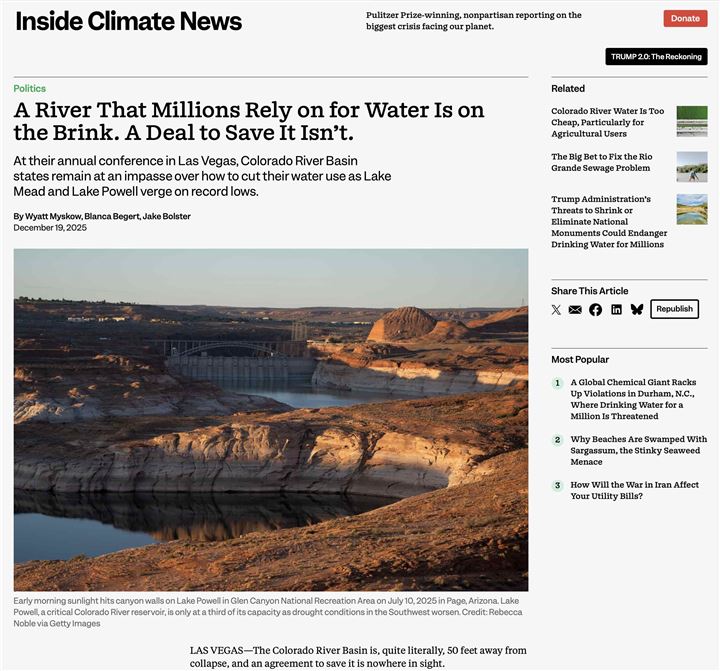
Story released on low flow of the Colorado River and the failure of western states to agree on a management plan.
Description
This project will strengthen news coverage of the most important environmental issues in the Mountain West. That includes reporting on: water, public lands, energy development and taxation, coal and mineral mining, carbon capture, clean energy, conservation and biodiversity, and state and federal politics and how they impact the people who live there. We will also pay close attention to the unique role that the West plays in mitigation and adaptation efforts through agriculture, landscape restoration, clean energy development and more - and if and when politics gets in the way. Our work will create a meeting place for consistent local conversation in and outside the region around vital issues of human and environmental health otherwise invisible, misunderstood, or ignored. The work will contribute to public discourse and understanding of the ways that energy policy affects lives.
Local news is in crisis. Almost 40 percent of all local U.S. newspapers have closed since 2005, with outlets in rural communities hit especially hard. According to a 2025 report from Muck Rack, every state in the Mountain West has fewer than 20 journalists per 100,000 residents – less than half the national average in 2002. Federal cuts to public media have further strained rural states, leaving stations across the Mountain West facing budget shortfalls, consolidation, or closure. Of the local newsrooms that remain viable, most can no longer afford dedicated environmental reporters.
This erosion of local journalism has real consequences. Research shows that when local news capacity declines, corporate misconduct increases. Voluntary disclosures by firms drop, as does civic engagement. The environmental impacts are demonstrable, with toxic emissions by local manufacturers rising with less press coverage. When reliable journalism disappears, public understanding diminishes, polarization hardens, and accountability erodes. Citizens are less aware about the quality of air and water in their neighborhoods and communities, and what is happening to their forests, rivers and mountains.
ICN works to fill the gap in local environmental coverage through our ICN Local network. In states across the country, our journalists produce original reporting on local climate and environment issues and share it for free with readers and local media partners, 300+ of whom re-publish our work. This model is a win-win that multiplies the impact of scarce resources: local outlets are able to publish environmental reporting that they may not have capacity to produce themselves, and in turn Inside Climate News is able to reach broader audiences, who may not otherwise seek out climate news on their own.
With the support from the Alex C. Walker Foundation, Inside Climate News’ Mountain West bureau had a strong year in 2025 and revved into 2026. ICN has two full-time reporters covering the Mountain West. This grant allowed us to add some much-needed freelance support in covering the largest region in the country — and lay the groundwork for a permanent expanded presence across the pivotal Mountain West.
9-Month Project Activities and Outcomes
Number of Mountain West stories:
From December 2025 - September 2026, ICN has published 63 original stories on issues critical to the Mountain West, including water, wildfires, conservation, fossil fuels, renewable energy, mining, and more.
Issues related to water, drought, and wildfire are becoming increasingly urgent in the region, especially after one of the driest winters on record. Our team is closely covering the contentious talks over how to manage the Colorado River Basin, which, due to climate change and overuse, is on the brink of collapse. In December, negotiators from the seven Colorado River Basin states remained at an impasse over how to cut their water use, heightening the risk that the federal government would have to step in to implement a plan to protect its infrastructure. In February, state authorities had begun talking about whether they were prepared for litigation as a means to an end, which could cause years of delayed action and uncertainty that could affect the planning of cities, tribes, and farmers waiting for new guidelines. By mid-2026, that federal intervention began to take shape. In July, the Bureau of Reclamation released an environmental impact statement outlining steep, mandatory reductions for Arizona, California, and Nevada to prevent Lake Mead and Lake Powell from reaching critically low levels.
Release of the federal plan immediately intensified political and legal conflict. In August, Nevada filed a lawsuit against the Trump administration, arguing that the new framework would impose “catastrophic impacts” on the state’s water users and unfairly burden the lower Basin without addressing long-standing structural inequities of the river’s management. State officials warned that litigation could drag on for years, delaying urgently needed action and deepening uncertainty for cities, tribes, and farmers awaiting post-2026 guidelines. Meanwhile, courts are shaping the physical landscape of the basin itself. In September, a federal appeals court allowed Colorado’s controversial proposal to expand a major Front Range Dam to move forward, despite objections from environmental groups who argue the project would further strain an already over-allocated river system. The ruling underscores how infrastructure decisions, along with stalled interstate negotiations, could lock in long-term consequences for water availability in the region.
Widespread drought paired with the upheaval in federal wildland firefighting has riveted wildfire experts, who predicted an especially severe wildfire season in the Mountain West. ICN data reporter Peter Aldhous scraped data from the National Oceanic and Atmospheric Administration, NASA, and U.S. Drought Monitor to sharply illustrate their fears: This spring, mountain ranges in the west were left with one of the lightest snowpacks in recent history. Soil moisture content across the nation was low. Ground and air conditions were drier than they had been so far this century. Additional reporting highlighted new climate attribution research showing that greenhouse gas-warming causes more frequent snow droughts in the area, and if warming continues at the current pace, a snow drought as severe and widespread as last winter’s could occur every third year by 2050, and nine out of 10 years by the end of the century. ICN also covered emerging science on precipitation, detailing how increasingly concentrated precipitation events can paradoxically cause drier conditions. As ICN followed the wildfire season, staff reporter Jake Bolster covered how Wyoming is reshaping fire preparedness and the strain on fire agencies and emerging strategies to protect communities.
Wildlife and conservation are another key focus. In April, Inside Climate News commissioned Blaine Harden, a seasoned journalist and author, to cover the proposed cancellation of leases for bison grazing on federal land managed by the Bureau of Land Management. The decision, which was formalized in May, targeted leases held by American Prairie, a conservation nonprofit that purchases ranchland with the goal of reviving prairie ecosystems with bison herds. Blaine’s beautifully written story reporting explored the history of conflict between American Prairie and cattle ranchers, as well as the implications of the ruling on tribal buffalo herds. One month after ICN’s story, the New York Times published its own report, illustrating ICN’s role in shaping public discourse and pulling in other media to write about important issues. In August, Jake Bolster profiled Colorado ranchers experimenting with new herd-management techniques in an effort to coexist with newly reintroduced wolves. Further reporting in September covered the ordered removal of gray and Mexican wolves from the endangered species list. ICN’s data analysis showed that wolves account for a small fraction of cattle losses, and other factors, like climate-fueled droughts, high fuel prices, persistent inflation, and the Trump administration’s decision to pause levies on hundreds of thousands of pounds of beef imports, are likely applying far more economic pressure to the industry than wolves.
Public lands across the Mountain West continue to fall under intense political, economic, and administrative pressure. In March 2026, ICN turned to southern Utah, where a battle over land protection was brewing. Two Republican lawmakers introduced a joint resolution of disapproval invoking the Congressional Review Act to nullify the resource management plan for Grand Staircase-Escalante National Monument, a move conservationists fear could serve as a blueprint for dismantling protections on other public lands across the West. In September, Jake Bolster reported on a major error in a Bureau of Land Management oil and gas lease sale. The agency mistakenly used outdated environmental review data to justify leasing 380,000 acres of federal land, prompting questions and concerns from residents and environmental groups. In Wyoming, public lands have become a major issue in the 2026 primaries, where voters overwhelmingly oppose efforts to transfer federal lands to state control. ICN covered how the backlash to 2025 land-transfer proposals has reshaped state politics, with even Republican candidates distancing themselves from sell-off agendas and new grassroots groups forming to defend access to national forests, monuments, and BLM lands.
ICN has closely tracked the region’s evolving energy landscape amid a rapidly shifting policy agenda. Jake Bolster wrote about a federal lawsuit aiming to halt the expansion of a longwall coal mine in Montana. The plaintiffs argue that the mine has been dewatering the area for over a decade, with impacts to local wildlife and ranching. Jake’s story went deep into the science of longwall mining and its impacts on water supplies and locals. In June, he also reported on the fiscal uncertainty facing Musselshell County, where the same mine anchors the local economy. A proposed federal land-transfer bill could strip the county of millions in tax revenue while a separate federal lawsuit could force the mine to shut down entirely. Local officials warned that either outcome could destabilize county finances, forcing cuts to public services and raising taxes for residents.
In January, freelance reporter Leigh Reagan Smith covered the approval by Laramie County, Wyoming commissioners of what could become the nation’s largest data center. The center’s initial capacity is estimated to be 1.8 gigawatts – over five times more than the amount that homes in Wyoming currently use – and could potentially scale up to 10 gigawatts. The project will be powered by natural gas, and potentially augmented by solar power in the future.
ICN also reported on several major policy and legal developments shaping the broader fossil-fuel landscape in the Mountain West. In July, ICN fellow Maya McDaniel covered Colorado’s proposed “Right to Natural Gas” constitutional amendment, a 60-word ballot measure that would enshrine the right of producers and utilities to sell methane gas. Environmental advocates warn it could undermine building code electrification efforts and slow the state’s climate goals. Staff reporter Lisa Sorg covered the Trump administration’s exploration of ways to unlock massive coal reserves under federal lands to support a broader agenda that weakens environmental regulations to expand fossil fuel production. ICN is also closely following the high-stakes Supreme Court case Suncor v. Boulder, in which oil companies are seeking to quash a climate-liability lawsuit brought by Boulder and other Colorado communities. This case will be first on the Court’s fall docket and could reshape the legal landscape for more than two dozen similar climate accountability suits nationwide.
Across every beat, ICN’s work is revealing how climate change is reshaping daily life and long-term planning in the Mountain West. Access to this reporting ensures that communities and decision-makers have trustworthy, deeply reported information as the stakes for the region continue to rise.
Number of partnerships and re-publications:
These stories are reaching audiences beyond the Inside Climate News website because of our robust partnership efforts with local and regional media outlets. ICN is now firmly established as a key node in the Mountain West media ecosystem. Since December 1, our Mountain West coverage has been re-published 38 times by 17 local news outlets, including Coyote Gulch, Wyoming Public Media, El Semanario, High Country News, High Plains Public Radio, Billings Gazette, Bozeman Daily Chronicle, Missoulian, WyoFile, Wyoming Tribune Eagle, Buckrail, Daily Montanan, Utah Junction, The Water Desk, and Kiowa County Press.
Our work also elevated regional issues to national audiences, with Mountain West stories re-published by national and state outlets outside the region 27 times. Re-publishing partners included Mother Jones, Grist, Vox, Maven’s Notebook, The Driller, Times of San Diego, Tucson Sentinel, South Dakota Searchlight, Highland County Press, Society of Environmental Journalism, Factor This, Yahoo! News, Source New Mexico, AZ Luminaria, and Tucson Sentinel. Additionally, Mountain West stories were re-published internationally by UNDRR Prevention Web and EcoTropical.
Beyond the news, our Mountain West stories were followed by policy makers and people who care deeply about the environment. They were shared by conservation groups and government offices, in a presentation at the CO River Water Users Association conference, on the social media pages of local environmental groups, and in newsletters published by universities including the University of Wyoming and Stanford’s Bill Lane Center for the American West.
Audience:
ICN now has a full-time staff of 42 people across the U.S. and in London, Vienna, and Turks & Caicos. We published over 1,400 stories last year, covering the most important climate, energy, and environmental justice issues, including longer narrative and investigative pieces that won awards and achieved positive change for communities and the environment. This work attracted millions of readers, more than 350,000 of them dedicated email subscribers. Our reach was amplified through co-publication with more than 300 partner news outlets and Apple News. This year we also launched a pilot of a brand new video podcast, Inside Climate, to bring our news to the growing segment of the population now consuming their news via video, audio, and social media.
Readership in the Mountain West:
Our expanded coverage in the Mountain West is also translating to more readers in the region. Our total Mountain West readership is up 16% over last year, with the largest audience growth taking place in Colorado (38%). Our work has also become a trusted source of information for public officials and government staff, with our newsletter subscribers including hundreds of employees in local and state government positions across the Mountain West, from Nevada’s Public Utilities Commission to Utah’s Department of Natural Resources, Wyoming’s Governor’s Office, Montana’s Department of Environmental Quality, and Colorado’s Energy Office, to name a few.
Purpose
This project will strengthen news coverage of the most important environmental issues in the Mountain West, including water, public lands, energy development and taxation, coal and mineral mining, carbon capture, clean energy, conservation and biodiversity, and state and federal politics and the way they are impacting the region’s residents. In shining a light on the issues we will also pay close attention to the unique ways that the West can play a role in mitigation and adaptation through agriculture, landscape restoration, clean energy development and more - that is, unless politics get in the way. Our work will create a consistent local conversation that captures attention in and outside the region around vital issues of human and environmental health otherwise invisible, misunderstood, or ignored.
Scope
This project will cover issues impacting the Mountain West region of the US. Stories written will be published on ICN's website, which reaches millions of readers annually, 350,000 of them dedicated subscribers. The work will be amplified through co-publication by local media partners in the region and by national partners.
Information Dissemination
Stories written will be published on ICN's website, which reaches millions of readers annually, 350,000 of them dedicated subscribers. The work will be amplified through co-publication by local media partners in the region and by national partners.
Project Linkhttps://insideclimatenews.org/local/mountain-west/
Amount Approved$20,000.00
on 11/25/2025
(Check sent: 12/7/2025)