Purpose
- Investigates the causes of economic imbalances.
Summary
This grant will expand high quality climate and energy news coverage in the Mountain West.
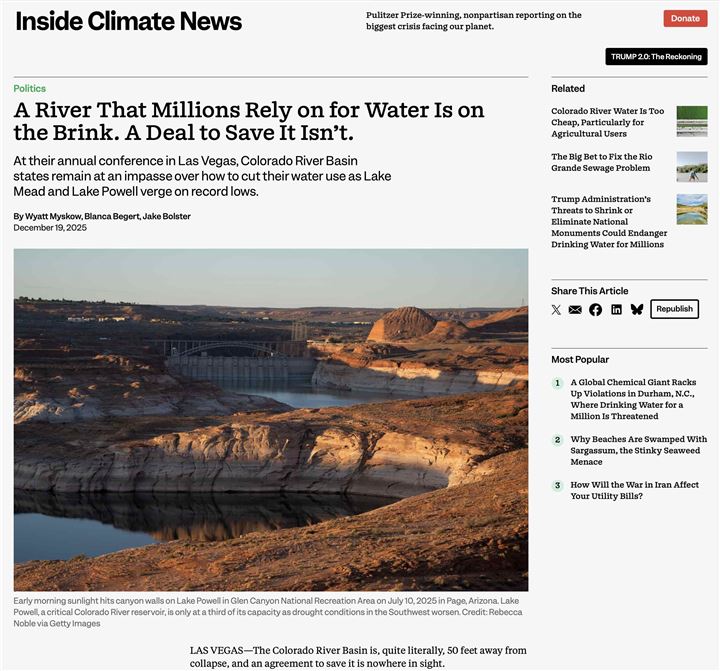
Story released on low flow of the Colorado River and the failure of western states to agree on a management plan.
Description
This project will strengthen news coverage of the most important environmental issues in the Mountain West. That includes reporting on: water, public lands, energy development and taxation, coal and mineral mining, carbon capture, clean energy, conservation and biodiversity, and state and federal politics and how they impact the people who live there. We will also pay close attention to the unique role that the West plays in mitigation and adaptation efforts through agriculture, landscape restoration, clean energy development and more - and if and when politics gets in the way. Our work will create a meeting place for consistent local conversation in and outside the region around vital issues of human and environmental health otherwise invisible, misunderstood, or ignored. The work will contribute to public discourse and understanding of energy policy affects lives.
Local news is in crisis. Almost 40 percent of all local U.S. newspapers have closed since 2005, with outlets in rural communities hit especially hard. According to a 2025 report from Muck Rack, every state in the Mountain West has fewer than 20 journalists per 100,000 residents – less than half the national average in 2002. Federal cuts to public media have further strained rural states, leaving stations across the Mountain West facing budget shortfalls, consolidation, or closure. Of the local newsrooms that remain viable, most can no longer afford dedicated environmental reporters.
This erosion of local journalism has real consequences. Research shows that when local news capacity declines, corporate misconduct increases. Voluntary disclosures by firms drop, as does civic engagement. The environmental impacts are demonstrable, with toxic emissions by local manufacturers rising with less press coverage. When reliable journalism disappears, public understanding diminishes, polarization hardens, and accountability erodes. Citizens are less aware about the quality of air and water in their neighborhoods and communities, and what is happening to their forests, rivers and mountains.
ICN works to fill the gap in local environmental coverage through our ICN Local network. In states across the country, our journalists produce original reporting on local climate and environment issues and share it for free with readers and local media partners, 300+ of whom re-publish our work. This model is a win-win that multiplies the impact of scarce resources: local outlets are able to publish environmental reporting that they may not have capacity to produce themselves, and in turn Inside Climate News is able to reach broader audiences, who may not otherwise seek out climate news on their own.
With the support from the Alex C. Walker Foundation, Inside Climate News’ Mountain West bureau had a strong year in 2025 and revved into 2026. ICN has two full-time reporters covering the Mountain West. This grant allowed us to add some much-needed freelance support in covering the largest region in the country — and lay the groundwork for a permanent expanded presence across the pivotal Mountain West.
6-Month Project Activities and Outcomes
Number of Mountain West stories:
From December 1 to June 8, ICN published 38 original stories on issues critical to the Mountain West, including water, wildfires, conservation, fossil fuels, renewable energy, mining, and more.
Issues related to water, drought and wildfire are becoming increasingly urgent in the region, especially after one of the driest winters on record. Our team is closely covering the contentious talks over how to manage the Colorado River Basin, which due to climate change and overuse, is on the brink of collapse. In December, negotiators from the seven Colorado River Basin states remained at an impasse over how to cut their water use, heightening the risk that the federal government will have to step in to implement a plan to protect its infrastructure. In February, state authorities had begun talking about whether they are prepared for litigation as a means to an end, which could cause years of delayed action and uncertainty that could affect the planning of cities, tribes and farmers waiting for new guidelines.
Widespread drought paired with the upheaval in federal wildland firefighting has riveted wildfire experts, who expect an especially severe wildfire season in the Mountain West. Inside Climate News data reporter Peter Aldhous scraped data from the National Oceanic and Atmospheric Administration, NASA, and U.S. Drought Monitor to sharply illustrate their fears: Mountain ranges in the west were left with one of the lightest snowpacks in recent history. Soil moisture content across the nation is low. Ground and air conditions are drier this time of year than they have been so far this century. Our team will continue to cover this story as the season unfolds.
Wildlife and conservation are another key focus. Here are some of the notable stories that drew in thousands of readers in recent months: In April 2026, Inside Climate News commissioned Blaine Harden, a seasoned journalist and author, to cover the proposed cancellation of leases for bison grazing on federal land managed by the Bureau of Land Management. The decision, which was formalized in May, targeted leases held by American Prairie, a conservation nonprofit that purchases ranchland with the goal of reviving prairie ecosystems with bison herds. Blaine’s beautifully written story reporting explored the history of conflict between American Prairie and cattle ranchers, as well as the implications of the ruling on tribal buffalo herds. One month after ICN’s story, the New York Times published its own report, illustrating ICN’s role in shaping public discourse and pulling in other media to write about important issues.
In December, staff writer Jake Bolster examined a potential conflict within the Trump administration's own agenda: The proposed rescission of the roadless rule (which bans new road construction in national forests) could undermine another of the administration's ambitions – delisting Yellowstone-area grizzly bears as endangered. Roadless areas provide critical secure habitat that the U.S. Fish and Wildlife Service previously cited as justification for delisting the grizzly.
That same month, ICN published a feature on the Lucky Peak bird research station in Idaho, which was devastated by the 2024 Valley Fire, but is now channeling that loss into a rare scientific opportunity. Researchers are sorting through 30 years of pre-fire banding data to study how birds and their habitats respond to climate-driven wildfires.
In March 2026, ICN turned to southern Utah, where a battle over public land protection was brewing. Two Republican lawmakers introduced a joint resolution of disapproval invoking the Congressional Review Act to nullify the resource management plan for Grand Staircase-Escalante National Monument, a move conservationists fear could serve as a blueprint for dismantling protections on other public lands across the West.
ICN has nimbly covered the region’s energy landscape amid a rapidly shifting policy agenda. Staff reporter Jake Bolster wrote about a federal lawsuit aiming to halt the expansion of a longwall coal mine in Montana. The plaintiffs argue that the mine has been dewatering the area for over a decade, with impacts to local wildlife and ranching. Jake’s story went deep into the science of longwall mining and its impacts on water supplies and local residents.
In January, freelance reporter Leigh Reagan Smith covered the approval by Laramie County, Wyoming commissioners of what could become the nation’s largest data center. The center’s initial capacity is estimated to be 1.8 gigawatts – over five times more than the amount that homes in Wyoming currently use – and could potentially scale up to 10 gigawatts. The project will be powered by natural gas, and potentially augmented by solar power in the future.
Jake Bolster also delved into rancher needs in the same expansive state when covering the fallout from the failed passage of Wyoming’s net metering bill and its impacts on ranchers hoping to use solar power to offset their electricity costs. The story followed two Cokeville cattlemen who had invested in solar systems, one using federal REAP grant funding, only to find themselves unable to recoup their investment without the ability to net meter beyond Wyoming's 25-kilowatt cap. The ranchers argued that the state's restrictive net metering laws put them at a competitive disadvantage compared to neighboring Idaho and Utah, where the same utility allows far larger solar systems to feed power back to the grid.
Number of partnerships and re-publications:
These stories are reaching audiences beyond the Inside Climate News website because of our robust partnership efforts with local and regional media outlets. ICN is now firmly established as a key node in the Mountain West media ecosystem. Since December 1st, our Mountain West coverage has been re-published 31 times by 13 local news outlets, including Coyote Gulch, Wyoming Public Media, El Semanario, High Country News, High Plains Public Radio, Billings Gazette, Bozeman Daily Chronicle, Missoulian, WyoFile, Wyoming Tribune Eagle, Buckrail, and Daily Montanan.
Our work also elevated regional issues to national audiences, with Mountain West stories re-published by national and state outlets outside the region 29 times. Re-publishing partners included Renewable Energy World, Ars Technica, Mother Jones, Vox, Daily Kos, Slate, Maven’s Notebook, The Driller, Times of San Diego, Tucson Sentinel, South Dakota Searchlight, Highland County Press, Lakota Times, 91.5 KJZZ Phoenix, Atmos, Lookout Santa Cruz, and Indian Country Today.
Beyond the news, our Mountain West stories were followed by policy makers and people who care deeply about the environment. They were shared by conservation groups and government offices, in a presentation at the CO River Water Users Association conference, on the social media pages of local environmental groups, and in newsletters published by universities including the University of Wyoming and Stanford’s Bill Lane Center for the American West.
Audience:
ICN’s Mountain West coverage reaches our fast-growing national audience. In 2025, ICN pageviews were up 126%. Total pageviews from all sources—which includes ICN, the 300+ media partner and Apple News–reached 46 million, or nearly a million pageviews a week in 2025. So far this year, traffic is surging again. We now have 16.8 million readers, 325,000 subscribers, and pageviews are up another 65% over the same time period last year, suggesting a strong demand for trustworthy climate and environmental news coverage around the U.S.
Readership in the Mountain West:
Our expanded coverage in the Mountain West is also translating to more readers in the region. As of June 7, readership is up 39% across the region, with the largest growth in Colorado (59%). Our work has also become a trusted source of information for public officials and government staff, with our newsletter subscribers including hundreds of employees in local and state government positions across the Mountain West, from Nevada’s Public Utilities Commission to Utah’s Department of Natural Resources, Wyoming’s Governor’s Office, Montana’s Department of Environmental Quality, and Colorado’s Energy Office, to name a few.
Purpose
This project will strengthen news coverage of the most important environmental issues in the Mountain West, including water, public lands, energy development and taxation, coal and mineral mining, carbon capture, clean energy, conservation and biodiversity, and state and federal politics and the way they are impacting the region’s residents. In shining a light on the issues we will also pay close attention to the unique ways that the West can play a role in mitigation and adaptation through agriculture, landscape restoration, clean energy development and more - that is, unless politics get in the way. Our work will create a consistent local conversation that captures attention in and outside the region around vital issues of human and environmental health otherwise invisible, misunderstood, or ignored.
Scope
This project will cover issues impacting the Mountain West region of the US. Stories written will be published on ICN's website, which reaches millions of readers annually, 350,000 of them dedicated subscribers. The work will be amplified through co-publication by local media partners in the region and by national partners.
Information Dissemination
Stories written will be published on ICN's website, which reaches millions of readers annually, 350,000 of them dedicated subscribers. The work will be amplified through co-publication by local media partners in the region and by national partners.
Project Link https://insideclimatenews.org/local/mountain-west/
Amount Approved$20,000.00
on 11/25/2025
(Check sent: 12/7/2025)